Japanese
  English
  French
  German
  Spanish
  Portuguese
  Dutch
Dutch  Italian
  Russian
  Chinese
  Korean
  Indonesian
  Thai
Thai  Vietnamese
  Arabic
  Turkish
  Hebrew
  Hindi
Hindi 

Step 1 – Conduct Local Market & Demand Research
- Confirm local demand: Find buyers including industrial factories, fuel distributors, heating companies and export traders.
- Research competitors: Learn their briquette quality, selling price, shape and supply capacity.
- Define your target product: Decide to produce industrial coal briquettes or civil heating coal balls.
- Check logistics cost: Ensure convenient transport channels for raw coal powder and finished briquettes.
Step 2 – Secure Stable Raw Material Supply
- Stable supply source directly controls your production cost.
- Test raw material moisture, particle size and ash content in advance.
- Prepare suitable binders such as bentonite, starch or clay according to coal characteristics.
Note: The ideal moisture of coal powder before briquetting should be controlled within 8%-12% to get high-strength finished briquettes.
Step 3 – Choose Factory Site & Plan Workshop Layout
- Close to raw material source or sales market to cut transport expense.
- Sufficient flat space for raw material storage, production line, finished goods warehouse.
- Stable 3-phase power supply matching machine requirements.
- Meet local environmental and noise regulations.
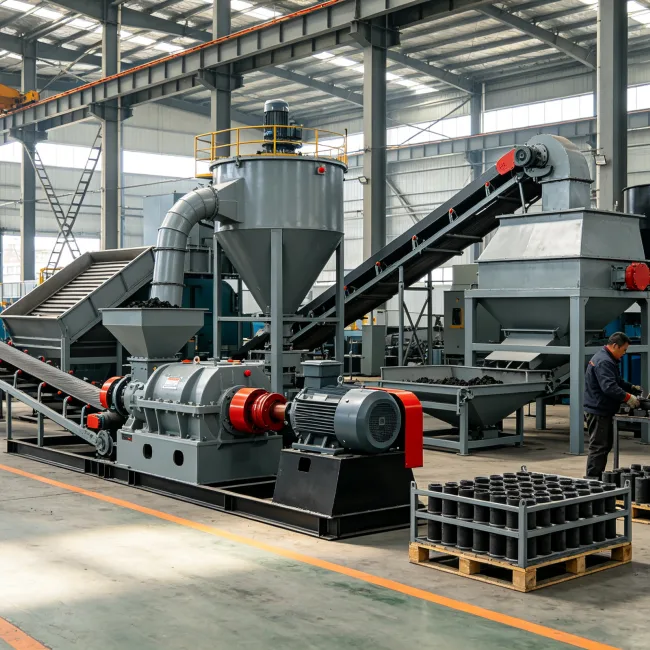
Step 4 – Select Suitable Coal Briquetting Equipment
- Coal Crusher: Crush bulk coal into fine powder
- Powder Mixer: Mix coal powder with binder and water evenly
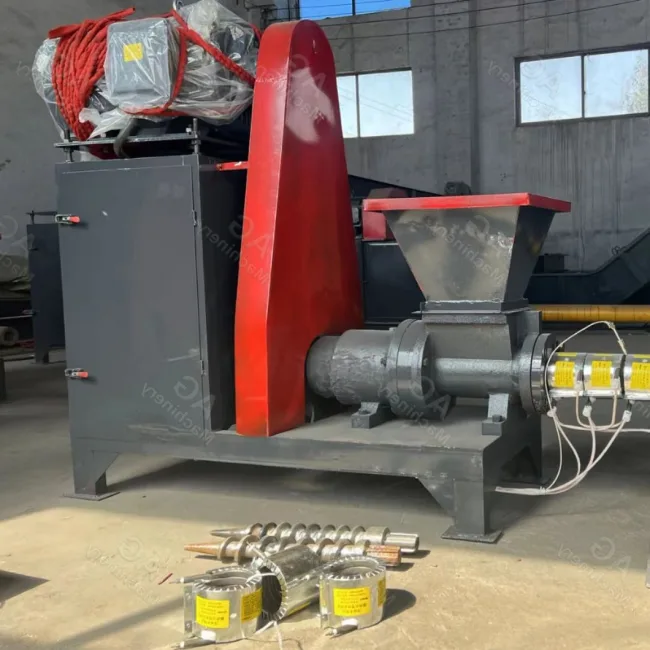
- ローラー式石炭ブリケット成形機: Core forming equipment for coal briquettes
- Belt Conveyor: Automatic material transportation between machines
- Rotary Dryer (Optional): Reduce moisture of fresh briquettes to avoid cracking
Investment Tip:
If you only need small-volume production, you can buy a single roller coal briquetting machine first. For long-term mass production, a full automatic production line will greatly lower labor cost.
Step 5 – Understand Standard Coal Briquette Production Process
The mature production workflow:
Raw Coal Powder → Crushing → Mixing → Briquetting → Drying → Finished Coal Briquettes
- Crushing: Break large coal lumps into qualified fine powder
- Mixing: Blend coal dust with binder and water uniformly
- Briquetting: Roller briquetting machine compresses powder into solid pillow-shaped or round coal briquettes
- Drying: Remove extra moisture, improve briquette hardness and storage performance
Step 6 – Calculate Investment Budget & Operation Cost
Your total investment mainly contains these parts:
✅ Equipment purchase (main cost)
✅ Factory rent or construction, machine foundation
✅ Raw material initial stock
✅ Labor cost, electricity and daily operation expense
✅ Packaging and transportation cost
Step 7 – Complete License & Environmental Formalities
- Industrial business registration
- Environmental protection permit (dust collection system may be required)
- Power consumption approval
If you plan to export finished coal briquettes, prepare relevant export certification in advance.
Step 8 – Quality Control & Sales Channel Building
- Briquette density and compression strength
- Burning time, ash content and smoke level
- Low breakage rate during transportation
Common Mistakes New Investors Should Avoid
- Buying mismatched machines without confirming raw material parameters
- Ignoring raw material moisture requirement, leading to fragile briquettes
- Saving budget on auxiliary equipment, resulting in discontinuous production
- No clear sales plan before building the plant
- Unreasonable workshop layout causing low production efficiency